← Back to Expertise
Overview
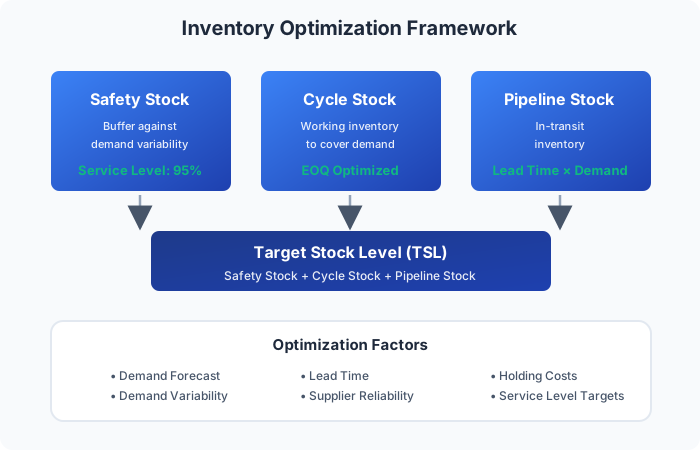
Target Stock Level (TSL) optimization is the science of determining the right amount of inventory to hold at each location in your supply chain network. Our sophisticated algorithms calculate optimal stock targets that minimize total costs while achieving desired service levels, accounting for demand uncertainty, lead time variability, and supply chain dynamics.
Unlike simple rule-of-thumb approaches, our TSL algorithms use advanced statistical methods, stochastic modeling, and multi-echelon optimization to set targets that are dynamically adjusted based on changing business conditions and performance feedback.
Core TSL Components
Safety Stock Calculation
Statistical determination of buffer inventory:
- Service Level Targeting: Calculating safety stock for target fill rates (95%, 98%, 99%+)
- Demand Variability: Modeling demand uncertainty using historical standard deviation or forecast error
- Lead Time Uncertainty: Accounting for supplier variability and delivery inconsistency
- Distribution Selection: Normal, gamma, negative binomial, or empirical distributions
- Seasonal Adjustment: Varying safety stock levels with seasonal demand patterns
Cycle Stock Determination
Working inventory to cover average demand:
- Average demand during replenishment lead time
- Order quantity impact on average cycle stock
- Economic order quantity (EOQ) consideration
- Minimum order quantity (MOQ) and pack size effects
- Review period impact on cycle stock requirements
Pipeline Inventory
In-transit and on-order inventory management:
- Calculating inventory in the supply chain pipeline
- Lead time × average demand rate
- Multi-modal transportation considerations
- Customs clearance and processing time buffers
- Visibility and tracking of pipeline stock
Advanced TSL Methodologies
Multi-Echelon Inventory Optimization (MEIO)
Network-wide TSL optimization:
- Guaranteed Service Model: Optimizing safety stock across echelons with service time guarantees
- Stochastic Service Model: Probabilistic modeling of stock-out risk propagation
- Network Structure: Serial, divergent, convergent, and general network topologies
- Risk Pooling: Exploiting centralization benefits in inventory positioning
- Working Capital Allocation: Optimal distribution of inventory investment across the network
Stochastic Inventory Models
Probabilistic approaches to TSL setting:
- (s, S) Policies: Reorder point (s) and order-up-to level (S) optimization
- (R, S) Policies: Periodic review with order-up-to level
- Newsvendor Model: Single-period inventory optimization
- Base Stock Policies: Continuous review order-up-to policies
- Service Level Constraints: Type I (cycle) and Type II (fill rate) service
Dynamic TSL Adjustment
Adaptive target levels responding to changing conditions:
- Forecast accuracy feedback and safety stock tuning
- Seasonal ramp-up and wind-down of inventory targets
- Supplier performance tracking and lead time adjustment
- Demand pattern changes and model re-estimation
- Service level achievement monitoring and correction
Segmentation-Based TSL
Differentiated targets by product characteristics:
- ABC Analysis: Higher service for A items, lower for C items
- XYZ Classification: Variability-based safety stock adjustment
- Criticality: Higher targets for business-critical products
- Lifecycle Stage: Different TSL approaches for introduction, growth, maturity, decline
- Value Density: Working capital considerations in TSL setting
TSL Optimization Techniques
Analytical Methods
Closed-form solutions for TSL calculation:
- Normal approximation for demand during lead time
- z-score calculation for desired service levels
- Square root law for safety stock aggregation
- Exact calculation for small discrete demand
- Continuous review vs. periodic review formulas
Simulation-Based Optimization
Modeling complex scenarios:
- Monte Carlo simulation of demand and lead time variability
- Multi-period inventory simulation
- Testing alternative TSL policies
- Scenario analysis for risk assessment
- Validation of analytical approximations
Machine Learning Approaches
Data-driven TSL optimization:
- Learning optimal TSL from historical performance
- Feature engineering for TSL prediction
- Clustering similar products for shared TSL policies
- Reinforcement learning for adaptive TSL adjustment
- Anomaly detection for TSL exceptions
Business Benefits
Reduced Inventory
Lower total inventory investment by 15-35% through scientific optimization
Improved Service
Achieve target service levels consistently with right-sized buffers
Better Cash Flow
Free up working capital tied in excess inventory
Risk Mitigation
Buffer against demand and supply uncertainty effectively
Dynamic Adaptation
TSL targets that automatically adjust to changing conditions
Network Optimization
Optimal inventory positioning across multi-echelon networks
Implementation Approach
Current State Assessment
Understanding existing TSL practices:
- Current TSL setting methodology review
- Inventory performance analysis (service levels, inventory turns)
- Data quality assessment (demand history, lead times, costs)
- Segmentation review and classification accuracy
- System capabilities for TSL management
Model Development
Building TSL calculation engines:
- Statistical parameter estimation from historical data
- Model selection based on product characteristics
- Multi-echelon network modeling
- Simulation model development and validation
- Optimization algorithm implementation
Policy Design
Creating actionable TSL rules:
- Service level targets by product segment
- Cost parameter definition (holding, shortage, ordering)
- Review frequency and recalculation triggers
- Override rules and manual adjustment protocols
- Exception management procedures
System Integration
Deploying TSL capabilities:
- Integration with inventory management systems
- Automated TSL calculation and updates
- Dashboard and reporting for TSL monitoring
- Alert generation for TSL exceptions
- Performance tracking and continuous improvement
Key Metrics & Monitoring
Service Level Metrics
- Fill Rate: Percentage of demand met from stock
- Cycle Service Level: Probability of no stock-out per replenishment cycle
- Ready Rate: Percentage of time with positive stock
- Backorder Rate: Frequency and duration of stock-outs
- Lost Sales: Unmet demand during stock-outs
Inventory Metrics
- Days of Supply: Current inventory divided by average daily demand
- Inventory Turns: Cost of goods sold divided by average inventory
- Excess Inventory: Stock above target levels
- Stock-out Inventory: Items below safety stock threshold
- Working Capital: Total inventory investment
TSL Performance
- Actual vs. target service level achievement
- Actual vs. TSL inventory variance
- TSL accuracy (how well targets predict needed stock)
- Parameter estimation quality (forecast error, lead time accuracy)
- Cost performance (actual vs. theoretical optimal)
Industry Applications
- Retail: Store inventory targets with daily demand variability
- Distribution: Multi-echelon TSL optimization across warehouse networks
- Manufacturing: Raw material and component TSL with production demand
- E-commerce: Fast-moving inventory targets for same-day fulfillment
- Automotive: Spare parts TSL with intermittent demand patterns
- Pharmaceutical: High-service TSL with expiration constraints
- Technology: TSL for products with rapid obsolescence risk
Best Practices
- Start with data quality—clean demand history is essential
- Segment products and use differentiated TSL policies
- Update TSL regularly (at least quarterly, monthly for fast-movers)
- Monitor actual service level achievement vs. targets
- Use multi-echelon optimization for network inventory positioning
- Balance system automation with human judgment for overrides
- Continuously improve parameter estimation and model accuracy
- Align TSL targets with business strategy and service commitments
Common Challenges
- Demand Forecasting: TSL quality depends on forecast accuracy
- Lead Time Variability: Supplier inconsistency requires larger buffers
- Intermittent Demand: Special methods needed for slow-moving items
- New Products: Limited data for TSL calculation at launch
- System Constraints: ERP limitations in TSL management
- Change Management: Moving from rules of thumb to scientific TSL
Get Started
Optimize your inventory targets with scientifically calculated TSL that balance service, cost, and risk. Contact us to discuss how our Target Stock Level algorithms can reduce inventory while improving service.
Email: info@l3v.solutions
 L3V Solutions