← Back to Expertise
Overview
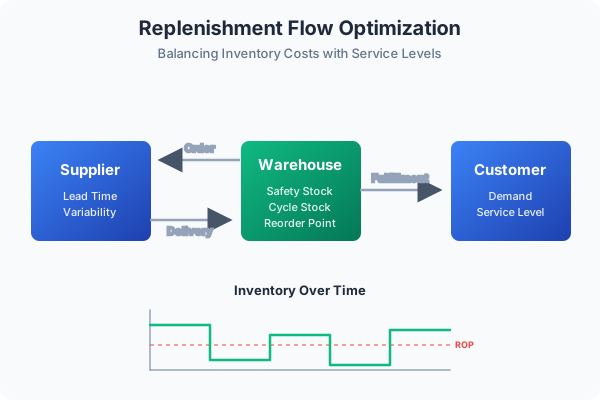
Replenishment optimization is the science of determining when and how much to order to maintain optimal inventory levels. Our advanced algorithms dynamically calculate order points, order quantities, and safety stock levels that minimize total costs while achieving your service level targets.
We move beyond fixed order cycles and static reorder points to create adaptive replenishment strategies that respond to changing demand patterns, lead time variability, and business constraints in real-time.
Core Replenishment Strategies
Economic Order Quantity (EOQ) Based Methods
We implement sophisticated variants of classic EOQ models that account for modern supply chain realities:
- Dynamic EOQ: Adjusting order quantities based on current demand rates and cost parameters
- Multi-Product EOQ: Joint optimization across product families with shared ordering costs
- Constrained EOQ: Incorporating budget, space, and capacity constraints
- Price Break Models: Optimizing order quantities with volume discounts and tiered pricing
Reorder Point (ROP) Systems
Our ROP calculations go beyond simple formulas to provide robust protection against stockouts:
- Statistical safety stock calculation using demand and lead time distributions
- Service level targeting (fill rate, cycle service level, or ready rate)
- Dynamic adjustment based on forecast accuracy and variability
- Lead time uncertainty modeling with supplier performance tracking
Periodic Review Systems
For businesses with fixed ordering cycles, we optimize review periods and order-up-to levels:
- (R, S) Policies: Fixed review period with variable order quantity
- (R, s, S) Policies: Review period with conditional ordering (order only if below s)
- Coordinated Replenishment: Synchronizing orders across multiple products
- Adaptive Review Periods: Adjusting cycle times based on demand patterns
Min-Max Inventory Control
Simple yet effective policies for operational environments:
- Scientifically determined minimum and maximum levels
- Algorithms that balance ease of implementation with performance
- Integration with warehouse management and ERP systems
- Exception-based alerts for parameter adjustment
Advanced Replenishment Techniques
Multi-Echelon Inventory Optimization (MEIO)
Optimize inventory across your entire supply chain network:
- Simultaneous optimization of safety stock at all echelons
- Consideration of upstream and downstream dependencies
- Risk pooling benefits in distribution network design
- Working capital allocation across the network
- Trade-offs between centralized and decentralized inventory
Stochastic Optimization
Handle uncertainty explicitly in replenishment decisions:
- Probabilistic demand and lead time modeling
- Risk-based inventory positioning
- Scenario analysis and robust optimization
- Simulation-based policy evaluation
Dynamic Programming
For complex, multi-period problems with changing conditions:
- Time-varying demand and cost structures
- Capacity-constrained ordering
- Perishable inventory management
- Product lifecycle considerations
Specialized Replenishment Scenarios
Perishable Products
Unique challenges for products with limited shelf life:
- Expiration date management and FEFO/FIFO policies
- Markdown and waste minimization
- Freshness-based service level targets
- Order quantity optimization considering obsolescence risk
Seasonal Products
Replenishment strategies for products with seasonal demand:
- Build-up and wind-down inventory curves
- Season start and end timing optimization
- Capacity reservation and pre-season ordering
- End-of-season clearance integration
High-Value, Low-Volume Items
Specialized approaches for expensive, slow-moving products:
- Lower safety stock targets with expedite options
- Emergency procurement protocols
- Risk-reward trade-offs in inventory investment
- Supplier consignment and VMI arrangements
Promotional Planning
Replenishment adjustments for promotional events:
- Promotional uplift forecasting and inventory build
- Display quantity optimization
- Post-promotion inventory management
- Forward buy versus just-in-time trade-offs
Technology & Implementation
Real-Time Replenishment Engines
Our systems provide continuous replenishment recommendations:
- Daily or more frequent order generation
- Integration with inventory management and procurement systems
- Automatic order release with configurable approval workflows
- Exception management and alert generation
What-If Analysis
Test replenishment strategies before implementation:
- Simulation of alternative policies
- Cost-service trade-off analysis
- Sensitivity to parameter changes
- Historical backtest validation
Performance Monitoring
Continuous tracking and improvement:
- Key metrics: fill rate, inventory turns, stockout frequency, carrying costs
- Policy performance dashboards
- Automated parameter tuning and recalibration
- Root cause analysis for exceptions
Business Benefits
Lower Inventory
Reduce average inventory levels by 15-30% while maintaining service
Higher Service
Achieve target fill rates with scientifically determined safety stocks
Reduced Costs
Lower ordering, holding, and expediting costs through optimization
Better Cash Flow
Free up working capital by eliminating excess inventory
Automation
Reduce manual effort in order generation and inventory management
Consistency
Standardize replenishment logic across products and locations
Our Approach
Assessment & Design
We begin by understanding your current state:
- Current inventory performance analysis
- Demand pattern segmentation (ABC-XYZ analysis)
- Supply chain network and constraint mapping
- Business objectives and service level requirements
- System and data capability assessment
Solution Development
Tailored algorithms for your specific needs:
- Policy selection by product segment
- Parameter calibration using historical data
- Simulation and validation
- Integration with existing systems
- User training and change management
Continuous Improvement
Ongoing support and optimization:
- Regular performance reviews
- Parameter tuning and policy adjustments
- New scenario implementation
- Best practice sharing and knowledge transfer
Industry Applications
- Retail: Store replenishment with daily ordering and promotional management
- Distribution: Multi-echelon optimization across DCs and regional hubs
- Manufacturing: Raw material and component replenishment with production constraints
- Healthcare: Medical supply replenishment with critical service levels
- Automotive: Spare parts replenishment with intermittent demand patterns
- Food & Beverage: Perishable product replenishment with freshness requirements
Get Started
Ready to optimize your replenishment strategy and unlock inventory efficiency? Contact us to discuss how our solutions can transform your inventory management.
Email: info@l3v.solutions
 L3V Solutions