← Back to Expertise
Overview
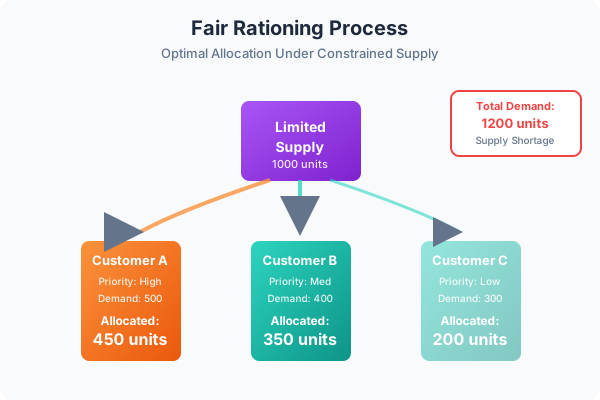
When demand exceeds available supply, rationing becomes essential. Our advanced rationing algorithms ensure fair, transparent, and strategically optimal allocation of constrained inventory to customers, channels, or locations. We help you balance competing objectives including customer equity, revenue maximization, strategic relationships, and long-term business health.
Effective rationing goes beyond simple pro-rata allocation. We design sophisticated mechanisms that consider customer importance, historical performance, contractual obligations, and business priorities while maintaining transparency and perceived fairness.
Rationing Methodologies
Priority-Based Allocation
Structured hierarchies that ensure critical needs are met first:
- Customer Tiering: Allocation based on customer classification (platinum, gold, silver, bronze)
- Contract Prioritization: Fulfilling committed volumes before discretionary demand
- Strategic Account Protection: Ensuring key customer relationships are preserved
- Channel Prioritization: Balancing allocation across retail, wholesale, e-commerce, and other channels
Fair Share Mechanisms
Equitable distribution approaches that maintain customer trust:
- Pro-Rata Allocation: Distribution proportional to demand or historical volume
- Equal Share: Allocating equal quantities when equity is paramount
- Needs-Based: Allocation based on inventory positions and service requirements
- Weighted Fair Share: Combining proportional allocation with priority adjustments
Economic Optimization
Maximizing business value during constrained supply:
- Revenue Maximization: Allocating to highest-margin or highest-revenue opportunities
- Profit Optimization: Considering both revenue and cost-to-serve
- Customer Lifetime Value: Factoring long-term customer worth into allocation decisions
- Opportunity Cost: Evaluating alternative uses and trade-offs
Game-Theoretic Approaches
Mechanism design for strategic allocation:
- Auction-Based: Price-based allocation mechanisms
- Shapley Value: Fair contribution-based allocation
- Nash Bargaining: Finding mutually acceptable solutions
- Incentive Compatibility: Designing mechanisms that encourage truthful demand reporting
Key Considerations
Fairness Metrics
Measuring and ensuring equitable outcomes:
- Fill rate parity across customer segments
- Gini coefficient for inequality measurement
- Variance in allocation ratios
- Historical allocation consistency
Constraint Management
Handling complex operational restrictions:
- Minimum order quantities and shipping restrictions
- Product substitution rules and alternatives
- Geographic and channel constraints
- Capacity and timing limitations
Dynamic Adjustment
Adapting to changing conditions:
- Real-time supply updates and reallocation
- Demand revision handling
- Emergency allocation protocols
- Rolling window allocation for ongoing constraints
Business Benefits
Fairness
Maintain customer trust through transparent, equitable allocation
Optimized Value
Maximize business outcomes within fairness constraints
Consistency
Apply standardized logic across all rationing situations
Speed
Rapid allocation decisions during supply disruptions
Auditability
Clear documentation and justification for allocation decisions
Flexibility
Configurable rules that adapt to different scenarios and products
Implementation Framework
Rationing Policy Design
Collaborative development of allocation rules:
- Stakeholder workshops to define priorities and fairness criteria
- Business rule documentation and approval
- Scenario testing and validation
- Communication strategy for transparency
System Integration
Seamless connection with order management:
- Real-time inventory visibility
- Demand capture and validation
- Automated allocation calculation and execution
- Order confirmation and customer notification
Governance & Monitoring
Ongoing oversight and improvement:
- Allocation performance dashboards
- Fairness metric tracking
- Exception management and manual override capability
- Post-event analysis and lessons learned
Industry Applications
- Retail: Hot product allocation during product launches or supply disruptions
- Manufacturing: Raw material rationing to production lines during shortages
- Healthcare: Critical supply allocation during emergencies (PPE, medications, vaccines)
- Consumer Goods: Promotional product allocation to customers and channels
- Automotive: Component rationing during supply chain disruptions
- Energy: Resource allocation during peak demand or supply constraints
Case Study Scenarios
Product Launch with Limited Supply
New, high-demand product with constrained initial availability:
- Balance market coverage with depth of inventory
- Prioritize strategic markets or accounts
- Manage customer expectations and wait lists
- Dynamic reallocation as production ramps up
Supply Chain Disruption
Sudden supply reduction due to supplier issues or natural disasters:
- Triage critical customer needs
- Identify substitution opportunities
- Coordinate across business units
- Plan for recovery and normalization
Seasonal Peak Constraints
Capacity limitations during high-demand periods:
- Pre-season allocation planning
- In-season adjustment protocols
- Customer commitment management
- Post-season reconciliation
Get Started
Prepare your organization for supply constraints with fair, strategic rationing processes. Contact us to design allocation mechanisms that protect both business value and customer relationships.
Email: info@l3v.solutions
 L3V Solutions