← Back to Expertise
Overview
Merchandise planning bridges the gap between strategic business goals and operational buying decisions. Our solutions help retailers and consumer goods companies develop merchandise financial plans that optimize sales, margin, inventory investment, and cash flow while aligning with demand forecasts and assortment strategies.
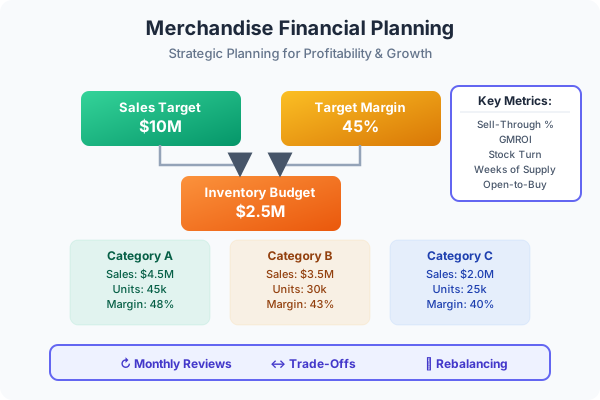
Effective merchandise planning balances top-down financial targets with bottom-up product-level plans, creating actionable buying roadmaps that drive profitable growth and efficient working capital management.
Core Components
Merchandise Financial Planning (MFP)
Top-down financial framework that sets targets:
- Sales Planning: Revenue targets by category, channel, and period
- Margin Planning: Initial markup, maintained markup, and gross margin targets
- Inventory Planning: Open-to-buy, stock-to-sales ratios, and turn targets
- Receipt Planning: Purchase timing and flow optimization
- Markdown Planning: Clearance strategy and margin protection
Assortment Planning
Product-level decisions within financial constraints:
- SKU selection and depth by location
- Good-better-best pricing architecture
- Brand and style mix optimization
- Color, size, and attribute planning
- New vs. carryover product balance
Open-to-Buy (OTB)
Dynamic purchasing authority management:
- Planned vs. actual sales reconciliation
- Receipt tracking and commitment management
- On-order and in-transit inventory visibility
- Buying capacity calculation
- Exception alerts and rebalancing
Pre-Season Planning
Strategic planning before seasonal commitment:
- Historical performance analysis
- Trend analysis and market intelligence
- Capacity and supplier capability assessment
- Financial target setting and approval
- Buy plan development and line review
Planning Methodologies
Top-Down Planning
Starting from financial targets and cascading down:
- Corporate sales and margin goals
- Division and category target allocation
- Store/channel distribution
- Time phasing (weekly/monthly)
- Product hierarchy breakdown
Bottom-Up Planning
Building from product-level forecasts:
- SKU-level demand forecasting
- Aggregation up the hierarchy
- Capacity and constraint consideration
- Comparison to top-down targets
- Gap identification and resolution
Reconciliation Process
Aligning top-down and bottom-up views:
- Variance analysis and root cause identification
- Iterative adjustment and negotiation
- Trade-off analysis (sales vs. margin vs. inventory)
- Scenario modeling and what-if analysis
- Final plan commitment and approval
Advanced Capabilities
Hindsight Analysis
Learning from past performance:
- Sell-through rate analysis
- Markdown effectiveness evaluation
- Stock adequacy assessment
- Missed opportunity quantification
- Success pattern identification
Option Planning
Managing seasonal buying uncertainty:
- Initial commitment vs. in-season option split
- Option exercise timing optimization
- Risk mitigation through flexibility
- Supplier capability and lead time management
- Cost of option vs. value of flexibility
Size and Pack Optimization
Getting the right size mix:
- Historical size selling patterns
- Size curve development by category and store
- Pack optimization for case pack constraints
- Minimize size stock-outs and markdowns
- Dynamic adjustment based on early sales
Allocation Planning
Store-level merchandise distribution:
- Store clustering and grading
- Initial allocation quantity determination
- Replenishment vs. pack and hold strategies
- Markdown timing and cross-store balancing
- Store-level inventory targets
Key Metrics & KPIs
Financial Metrics
- GMROI: Gross Margin Return on Investment
- IMU: Initial Markup percentage
- MMU: Maintained Markup after markdowns
- Sales per Square Foot: Space productivity
- Sell-Through Rate: Percentage of inventory sold
Inventory Metrics
- Stock-to-Sales Ratio: Weeks of supply on hand
- Inventory Turns: How many times inventory is sold per year
- Days of Supply: How long current inventory will last
- In-Stock Rate: Product availability percentage
- Aged Inventory: Percentage over target age
Planning Accuracy
- Plan vs. actual variance (sales, margin, receipts)
- Forecast accuracy at different horizons
- OTB consumption rate
- Markdown rate vs. plan
- Lost sales estimation
Business Benefits
Higher Margins
Improve maintained markup through better planning and reduced markdowns
Optimized Inventory
Reduce working capital while maintaining in-stock targets
Better Buying
More strategic, data-driven purchase decisions
Improved Turns
Faster inventory velocity through better planning
Sales Growth
Reduce out-of-stocks and capture more demand
Alignment
Connect merchandising strategy to financial objectives
Implementation Approach
Planning Process Design
Creating the merchandise planning framework:
- Planning calendar development
- Roles and responsibilities definition
- Approval workflow design
- Exception management protocols
- Cross-functional collaboration mechanisms
System & Tool Selection
Technology enablement for planning:
- Merchandise planning system evaluation and selection
- Integration with demand forecasting, assortment, and allocation systems
- ERP and financial system connectivity
- Reporting and dashboard development
- Mobile and workflow tools
Data Foundation
Building robust data infrastructure:
- Historical sales and inventory data cleansing
- Product hierarchy and attribute standardization
- Store/location master data management
- Financial data integration
- External data sources (weather, economic indicators)
Change Management
Driving adoption and capability building:
- Buyer and planner training programs
- Process documentation and playbooks
- Pilot season execution
- Performance monitoring and coaching
- Continuous improvement culture
Industry Applications
- Fashion Apparel: Seasonal merchandise planning with style, color, and size complexity
- Department Stores: Multi-category planning with diverse product lifecycles
- Specialty Retail: Focused category planning with deep assortments
- Mass Merchants: High-volume planning with private label mix
- Home Goods: Seasonal and event-driven merchandise planning
- Consumer Electronics: Fast-moving categories with rapid obsolescence
Best Practices
- Start planning early—pre-season planning is critical
- Use hindsight analysis systematically to improve future plans
- Balance art (merchant intuition) and science (data analytics)
- Plan at the right level of detail—not too high, not too granular
- Monitor OTB weekly and adjust dynamically
- Integrate merchandise planning with demand forecasting
- Foster collaboration between merchants, planners, and operations
- Measure and reward based on GMROI and sell-through, not just sales
Get Started
Elevate your merchandise planning capabilities to drive profitability and inventory efficiency. Contact us to discuss how our solutions can transform your planning process.
Email: info@l3v.solutions
 L3V Solutions