← Back to Expertise
Overview
Accurate demand forecasting is fundamental to effective supply chain management. Our forecasting solutions leverage cutting-edge statistical methods, machine learning algorithms, and domain expertise to generate reliable predictions that drive better inventory decisions, production planning, and resource allocation.
We go beyond simple time series analysis to incorporate causal factors, external variables, and business intelligence, creating comprehensive forecasting systems that adapt to your business dynamics and continuously improve over time.
Forecasting Methodologies
Time Series Analysis
We employ a comprehensive suite of time series techniques tailored to different demand patterns:
- ARIMA/SARIMA Models: For products with trend and seasonal patterns, capturing both autoregressive and moving average components
- Exponential Smoothing: Including Holt-Winters methods for data with trend and seasonality, providing adaptive forecasts that respond to recent changes
- Prophet: Facebook's robust forecasting tool that handles multiple seasonalities and holiday effects automatically
- Structural Time Series: Decomposing demand into trend, seasonal, and irregular components for better interpretability
- State Space Models: Flexible frameworks that handle missing data and structural breaks elegantly
Machine Learning Approaches
For complex demand patterns and large datasets, we leverage advanced machine learning techniques:
- Gradient Boosting: XGBoost and LightGBM for capturing non-linear relationships and interactions
- Neural Networks: Deep learning architectures including LSTM and GRU for sequence prediction
- Random Forests: Ensemble methods that handle multiple predictors and provide feature importance insights
- Temporal Convolutional Networks: Modern architectures specifically designed for time series forecasting
Causal Forecasting
Understanding what drives demand is as important as predicting it. Our causal models incorporate:
- Price and promotional effects with elasticity modeling
- Marketing campaign impacts and media mix contributions
- Competitive actions and market share dynamics
- Economic indicators and macroeconomic factors
- Weather patterns and external events
- Calendar effects including holidays, weekends, and special events
Specialized Forecasting Scenarios
New Product Forecasting
Predicting demand for products without historical data requires specialized approaches. We use:
- Analogous product analysis leveraging similar items' launch patterns
- Market research integration and expert judgment incorporation
- Bass diffusion models for innovation adoption curves
- Pre-launch indicator tracking and early signal detection
Intermittent Demand
For slow-moving and sporadic items, traditional methods often fail. We implement specialized techniques:
- Croston's method and its variants (SBA, TSB) for intermittent patterns
- Probability-based approaches that forecast demand occurrence and size separately
- Bootstrapping techniques for uncertainty quantification
Hierarchical Forecasting
Forecasting at multiple levels of aggregation requires reconciliation. Our solutions provide:
- Top-down, bottom-up, and middle-out approaches
- Optimal reconciliation using trace minimization
- Coherent forecasts across all hierarchy levels
- Automatic selection of optimal aggregation strategy
Forecast Accuracy & Evaluation
Performance Metrics
We employ comprehensive metrics to evaluate and monitor forecast quality:
- MAPE, WMAPE: Percentage errors for relative accuracy assessment
- RMSE, MAE: Absolute error metrics for scale-dependent evaluation
- Bias: Tracking systematic over- or under-forecasting tendencies
- Forecast Value Added (FVA): Measuring the improvement over naive benchmarks
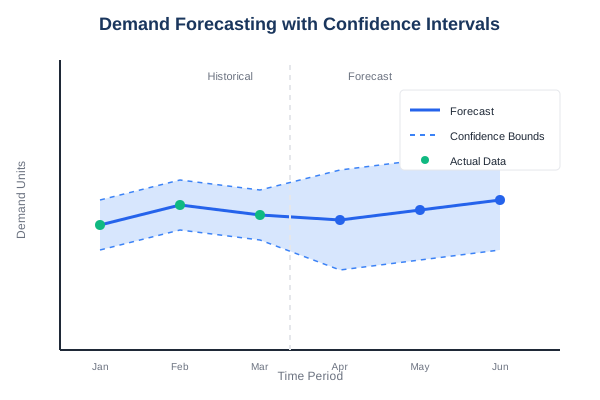
- Prediction Intervals: Quantifying forecast uncertainty with confidence bounds
Continuous Improvement
Forecasting systems should evolve with your business. We implement:
- Automated model selection and hyperparameter tuning
- Champion-challenger frameworks for continuous model evaluation
- Anomaly detection to identify and handle outliers
- Feedback loops incorporating actual outcomes to refine models
- Regular performance reviews and model recalibration
Business Benefits
Reduced Inventory
Lower safety stock requirements through improved forecast accuracy
Higher Service Levels
Fewer stockouts and backorders by anticipating demand more accurately
Cost Savings
Reduce expediting costs, markdowns, and obsolescence
Better Planning
Enable more effective production, procurement, and workforce planning
Improved Collaboration
Create a single source of truth for cross-functional planning
Strategic Insights
Understand demand drivers and market dynamics for better decision-making
Implementation Approach
Data Foundation
Successful forecasting starts with quality data. We help you:
- Identify and collect relevant internal and external data sources
- Clean and preprocess historical data to remove anomalies
- Handle missing values and data quality issues
- Establish data governance and maintenance processes
Model Development
Our structured approach ensures robust, production-ready forecasting systems:
- Exploratory data analysis to understand patterns and relationships
- Feature engineering to create predictive variables
- Model training, validation, and testing on out-of-sample data
- Ensemble approaches combining multiple models for robustness
- Calibration to align predictions with business requirements
Integration & Deployment
We ensure seamless integration with your existing systems:
- API-based forecast delivery for real-time access
- Batch processing for large-scale forecast generation
- Integration with ERP, planning, and BI systems
- User-friendly interfaces for forecast review and override
- Automated monitoring and alerting for performance degradation
Industry Applications
- Retail: Store-level demand forecasting with promotional and price effects
- E-commerce: High-frequency forecasting for online channels with real-time updates
- Manufacturing: Production planning forecasts incorporating lead times and capacity
- Consumer Goods: Multi-channel forecasting with trade promotion modeling
- Automotive: Spare parts forecasting with vehicle population and age modeling
- Healthcare: Patient demand and medical supply forecasting
Get Started
Transform your planning with forecasting solutions that deliver measurable improvements in accuracy and business outcomes. Contact us to discuss your forecasting challenges.
Email: info@l3v.solutions
 L3V Solutions