← Back to Expertise
Overview
Demand planning is more than forecasting—it's a comprehensive process that integrates statistical predictions, market intelligence, collaborative input, and business strategy to create a unified demand signal that drives supply chain execution. Our solutions bring together advanced analytics, workflow automation, and collaboration tools to create robust demand planning capabilities.
We help organizations move from fragmented, spreadsheet-driven processes to integrated, systematic demand planning that improves accuracy, reduces bias, and creates alignment across sales, marketing, operations, and finance.
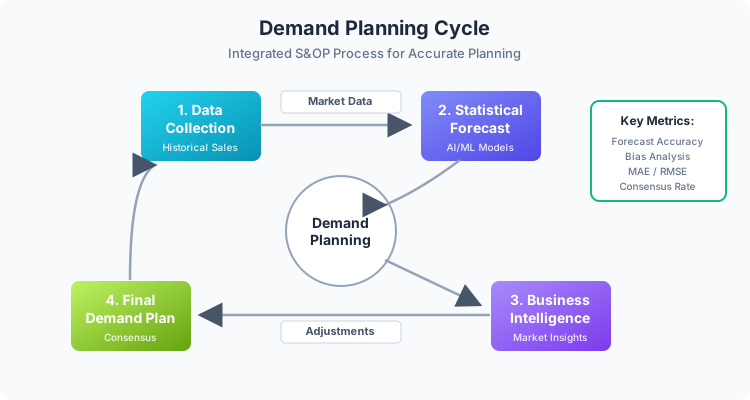
Demand Planning Framework
Statistical Baseline
Foundation built on rigorous quantitative methods:
- Time series forecasting with advanced algorithms
- Causal modeling incorporating price, promotion, and external factors
- Machine learning for complex pattern recognition
- Automatic model selection and ensemble approaches
- Forecast hierarchy reconciliation
Demand Sensing
Near-term forecast refinement with real-time signals:
- Point-of-sale data integration
- Shipment and order pattern analysis
- Channel inventory visibility
- Weather and event-based adjustments
- Short-term forecast accuracy improvement
Demand Shaping
Proactive influence on demand patterns:
- Promotional planning and trade spending optimization
- Price optimization and markdown strategies
- New product launch planning
- Inventory-driven demand smoothing
- Capacity-constrained demand management
Collaborative Planning
Structured process for human intelligence integration:
- Sales input and market intelligence gathering
- Marketing event calendar integration
- Customer forecast collaboration (CPFR)
- Consensus demand review meetings
- Override management and audit trails
Planning Process Design
S&OP Integration
Demand planning as foundation of Sales & Operations Planning:
- Demand Review: Statistical forecast presentation and enrichment
- Supply Review: Capacity and constraint identification
- Gap Analysis: Demand-supply imbalance resolution
- Pre-S&OP: Scenario development and recommendation preparation
- Executive S&OP: Decision-making and commitment
Planning Cycle
Structured rhythm for demand planning activities:
- Rolling horizon planning (typically 18-24 months)
- Monthly planning cycle with weekly updates
- Frozen, slushy, and liquid planning zones
- Exception-based management for efficiency
- Continuous monitoring between formal cycles
Planning Hierarchies
Multi-level planning for different purposes:
- Time Aggregation: Daily, weekly, monthly, quarterly views
- Product Hierarchy: SKU, family, category, business unit
- Geographic Hierarchy: Location, region, market, global
- Customer Hierarchy: Account, segment, channel, total
- Top-down and bottom-up reconciliation
Advanced Capabilities
Promotion Planning
Specialized forecasting for promotional events:
- Baseline and incremental volume separation
- Promotion effectiveness measurement
- Cannibalization and halo effect quantification
- Forward buy and pantry loading adjustment
- Promotion optimization and trade spend ROI
New Product Forecasting
Planning for products without history:
- Analogous product analysis
- Market research integration
- Adoption curve modeling
- Early sales signal tracking
- Ramp plan development
Lifecycle Management
Planning across product lifecycle stages:
- Introduction: Launch planning and ramp-up
- Growth: Expansion and scale planning
- Maturity: Stable demand management
- Decline: Phase-out and inventory wind-down
- Portfolio optimization and rationalization
Risk Management
Planning under uncertainty:
- Demand variability quantification
- Scenario planning (optimistic, base, pessimistic)
- Forecast value at risk (FVaR)
- Supply risk and mitigation planning
- Business continuity planning
Technology & Tools
Planning Platforms
Integrated systems for demand planning:
- Centralized data repository and forecast database
- Statistical engine integration
- Collaborative workflow management
- Reporting and visualization dashboards
- Integration with ERP, CRM, and BI systems
Analytics & Insights
Actionable intelligence from demand data:
- Forecast accuracy tracking and KPI dashboards
- Bias detection and alert management
- Demand pattern classification
- Demand driver analysis
- What-if simulation capabilities
Automation & AI
Intelligent automation for planning efficiency:
- Automatic forecast generation at scale
- Anomaly detection and outlier management
- Smart alerts and exception prioritization
- Natural language processing for unstructured input
- Reinforcement learning for adaptive planning
Business Benefits
Improved Accuracy
Increase forecast accuracy by 20-40% through better methods and processes
Lower Inventory
Reduce safety stock and excess inventory with better demand visibility
Higher Service
Improve product availability and customer satisfaction
Cost Reduction
Lower expediting, overtime, and excess capacity costs
Alignment
Create cross-functional agreement on demand outlook
Agility
Respond faster to market changes and opportunities
Implementation Approach
Current State Assessment
Understanding existing capabilities and gaps:
- Process maturity evaluation
- Data availability and quality assessment
- System capability review
- Organizational readiness analysis
- Forecast performance baseline
Process Design
Creating the target operating model:
- Planning process workflow definition
- Roles and responsibilities assignment (RACI)
- Meeting cadence and agenda design
- Metrics and KPI framework
- Governance structure and escalation paths
Tool Implementation
Technology enablement:
- System selection or enhancement
- Data integration and ETL development
- Model development and calibration
- User interface configuration
- Testing and validation
Change Management
Ensuring adoption and sustainment:
- Stakeholder engagement and communication
- Training program development and delivery
- Pilot execution and learning capture
- Full deployment and hypercare support
- Continuous improvement mechanisms
Industry Applications
- Consumer Goods: CPG demand planning with promotional complexity and retailer collaboration
- Retail: Multi-channel demand planning with localized forecasts
- Manufacturing: Make-to-order and make-to-stock planning with capacity constraints
- Pharmaceutical: Demand planning with regulatory constraints and long lead times
- High-Tech: Rapid product lifecycle planning with demand volatility
- Automotive: Complex BOM planning with aftermarket and OEM channels
Best Practices
- Start with a strong statistical baseline before adding judgment
- Measure and monitor forecast accuracy consistently
- Focus on forecast value added (FVA) not just accuracy
- Keep the process simple and exception-based
- Foster collaboration but avoid "too many cooks"
- Continuously improve through root cause analysis
- Align incentives with forecast accuracy and supply chain performance
Get Started
Transform your demand planning capabilities to drive better business outcomes. Contact us to discuss how our integrated approach can improve forecast accuracy and supply chain performance.
Email: info@l3v.solutions
 L3V Solutions