← Back to Expertise
Overview
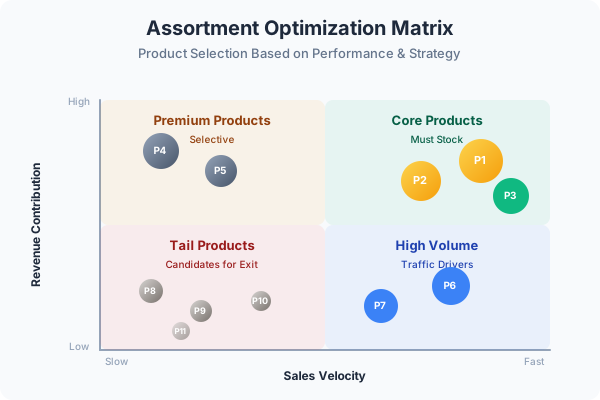
Assortment optimization determines which products to carry and where to place them to maximize revenue, profit, and customer satisfaction while respecting space, capacity, and strategic constraints. Our advanced algorithms leverage choice modeling, optimization techniques, and data analytics to create assortments that resonate with customer preferences and drive business performance.
Effective assortment planning balances variety (offering customers choice) with efficiency (managing complexity and costs). We help you find the optimal trade-off for your specific business context and customer segments.
Core Methodologies
Choice Modeling
Understanding how customers select products from available options:
- Multinomial Logit (MNL) Models: Predicting customer choice probabilities based on product attributes
- Nested Logit: Capturing hierarchical decision structures (category then brand then SKU)
- Mixed Logit: Modeling heterogeneous preferences across customer segments
- Attraction Models: Estimating demand as a function of assortment composition
- Substitution Patterns: Understanding product substitutability and complementarity
Optimization Formulations
Mathematical approaches to assortment selection:
- Knapsack Problems: Selecting products subject to space or budget constraints
- Integer Programming: Binary decisions (carry/don't carry) with multiple objectives
- Submodular Optimization: Exploiting diminishing returns structure
- Multi-Objective Optimization: Balancing revenue, profit, variety, and strategic goals
Data-Driven Insights
Leveraging analytics to inform assortment decisions:
- Sales and transaction data analysis
- Market basket analysis and affinity relationships
- Price elasticity and cross-price effects
- Competitive assortment benchmarking
- New product performance prediction
Assortment Strategies
Localized Assortments
Tailoring product selection to local markets:
- Cluster-Based: Grouping stores/customers with similar preferences
- Micro-Market: Store-specific assortments based on local demographics and preferences
- Space-to-Sales: Allocating shelf space proportional to category performance
- Climate and Regional: Adjusting for geographic and seasonal factors
Category Management
Strategic approach to product category decisions:
- Category role definition (destination, routine, seasonal, convenience)
- Good-better-best product tiering
- Brand portfolio management (national vs. private label)
- Price point coverage and price architecture
- Variety vs. duplication trade-offs
Planogram Optimization
Physical shelf space allocation:
- Shelf position and facing optimization
- Vertical and horizontal product placement
- Eye-level and reach considerations
- Cross-merchandising opportunities
- Compliance monitoring and execution
Lifecycle Management
Dynamic assortment evolution:
- New Product Introduction: Making room for innovation while managing risk
- Product Rationalization: Identifying underperformers for delisting
- Seasonal Transitions: Timing assortment changes for seasonal products
- Continuous Improvement: Regular assortment reviews and adjustments
Advanced Applications
Multi-Channel Assortment
Coordinating across retail channels:
- Online vs. in-store product selection
- Endless aisle and extended assortment strategies
- Omnichannel inventory visibility and availability
- Channel-specific assortment differentiation
Private Label Strategy
Optimizing store brand portfolios:
- National brand vs. private label mix
- Private label tiering (economy, mainstream, premium)
- Category penetration targets
- Profitability optimization with private labels
Promotional Assortment
Temporary assortment for events and promotions:
- Promotional product selection and depth
- Event-based assortment (holidays, back-to-school)
- Limited time offers and scarcity tactics
- Post-promotion cleanup and markdown optimization
Business Benefits
Revenue Growth
Increase sales by offering products customers actually want
Higher Margins
Optimize mix toward higher-margin products
Reduced Complexity
Eliminate low-value SKUs and simplify operations
Lower Inventory
Reduce working capital with focused assortments
Better Service
Improve availability on items that matter most
Customer Satisfaction
Match assortment to customer needs and preferences
Implementation Process
Discovery & Analysis
Understanding current state and opportunities:
- Current assortment performance assessment
- Sales data analysis and pattern identification
- Customer segmentation and preference analysis
- Competitive assortment benchmarking
- Space and capacity constraint documentation
Model Development
Building optimization capabilities:
- Choice model estimation from historical data
- Substitution pattern identification
- Optimization model formulation
- Scenario testing and validation
- What-if analysis capabilities
Strategy Design
Creating actionable assortment plans:
- Assortment strategy definition by channel and format
- Store clustering and localization rules
- Product introduction and exit criteria
- Space allocation guidelines
- Governance and approval workflows
Execution & Monitoring
Implementing and tracking results:
- Phased rollout and testing
- Integration with merchandising and planning systems
- Performance dashboards and KPI tracking
- Continuous feedback and refinement
- A/B testing for assortment changes
Industry Applications
- Grocery Retail: Category assortment with thousands of SKUs across hundreds of categories
- Fashion & Apparel: Seasonal assortment planning with size and color variants
- Consumer Electronics: Fast-moving categories with rapid product turnover
- Home Improvement: Deep assortments with professional and DIY segments
- Convenience Stores: Limited space optimization for high-turn products
- E-commerce: Virtual shelf optimization with recommendation integration
Key Metrics
Measuring assortment effectiveness:
- Sales per SKU: Productivity of each item in the assortment
- Gross Margin Return on Investment (GMROI): Profitability relative to inventory investment
- Assortment Breadth and Depth: Number of categories and items per category
- Stock-Out Rate: Availability of assorted products
- Substitution Rate: Frequency of customers choosing alternatives
- Market Basket Size: Number of items per transaction
Get Started
Optimize your product assortment for maximum profitability and customer satisfaction. Contact us to discuss how data-driven assortment optimization can transform your merchandising strategy.
Email: info@l3v.solutions
 L3V Solutions